ღ

GLOBAL FAMILY 1ღ COLLABORATING and COCREATING a LOVING,PEACEFUL, JUST and SUSTAINABLE WORLD.
Showing posts with label balance. Show all posts

The Auric Field


by Cyndi Dale -

The First Line of Energetic Defense:

The best known energy organ is the auric field. The aura can be visualized as a complex layer of energy bodies that surround your entire physical body. 

Each auric layer, numbering twelve in all, is like a layer of saran wrap that has a different physical, emotional, mental and spiritual purpose. 

All auric layers set boundaries, screen energetic data and regulate your relationship with the outside world.

The aura is more than fantasy. Artists and other sensitive people have long seen auras, usually as bands of color around a person or other animate being

Sensitives who can see the aura usually describe multiple energetic layers, each with a different color or pattern. 

I, as well as many others, perceive at least twelve such auric layers around the human body.

Each of these layers performs several vital functions, one of which is to screen different types of energetic information. For instance, one of the auric layers filters emotional data. 

Based upon conscious, unconscious and subconscious programming, this second auric field energetically decides what feelings to allow into your body and which feelings to send into the world. Feelings, like all aspects of life, are frequencies. 

Sadness vibrates at a different rate than does anger or fear. If you are programmed to perceive fear but ignore anger, you can psychically read when someone is scared but not necessarily pick up on someone else’s anger.

Each auric layer is in charge of certain frequencies or information-energy packets. 

The various layers filter everything from physical sensations to intellectual understandings to others’ spiritual beliefs. 

When all systems are up and functioning, it’s like having an force field protecting you. 

Good auric boundaries will also assure that you don’t “tip off” intruders, accidentally informing other people of your plans or moves.


Bookmark and Share

How To Stop Fearing Loneliness


by Angie Sarhan -

Whether it’s loved ones, neighbors, colleagues, friends, acquaintances, or strangers, our days often consist of having to interact, to talk, to listen, and to give of ourselves, without any time alone.

Sure, we enjoy, but often the result is that when we find ourselves in solitude, we get scared.

It's surprising how easy it is to go from being uncomfortable in a room alone to fearing that there's no one to love us, and no one there to be a witness to our lives.

I had a friend who feared being alone. To avoid that discomfort, she was became a serial monogamist. never so much as pausing for a breath between boyfriends.

With each new relationship, there was a tiny shift in her personality. It was obvious to see how she transformed a bit, depending on who she was dating. During that time, without any solitude, she lost sight of who she was.

The most important relationship we can foster is the one with ourselves.

Being human means we crave the love of people who understand us on our deepest levels. We crave complete acceptance with no judgment. And of course, being with others and interacting — even just through conversation — is one of the greatest pleasures in life.

Love and attention offer us comfort and peace. But solitude can be a blessing. You just have to choose to see it that way.

Constant chatter, constant thinking, and constant back-and-forth conversation with others can drain us. We can get so consumed by others’ lives, wishes, hopes, and dreams that we may lose sight of our own.

Sometimes when we sit with ourselves to think about a situation, it can be other people’s voices we hear rather than our own.

If we are not in tune with our minds, bodies, and spirits, we can eventually lose our way. That’s what happened to my friend.

Eventually she realized she needed some time and space alone to rediscover herself. She learned more in that space about who she was and what she really wanted than she had in the years she had spent in all those relationships, never taking the time for herself.

Can being alone be lonely? 

Absolutely.

Solitude can also be one of our greatest blessings. 

It gives us the space to process things happening around us, to think, to discover, and to feel our lives more fully.

In solitude we often have long-needed epiphanies, come to terms with our lives, sort out dilemmas, and make clear-headed decisions.

Providing or embracing solitude for ourselves makes us more energized for when we are with other people.

The next time you find yourself alone, ask how you can use this time to your advantage. Be mindful of the ways you can enjoy solitude so it brings you more peace and makes you more present.

Appreciate the gift of solitude by catching up on things you’ve been wanting to do — whether it’s personal projects or meditating in a relaxing space.

You may even want to write a list of ideas so when the time presents itself, you are already prepared and less likely to feel despondent or lonely.

Recognize that there are different seasons in our lives. Some are meant to be quieter than others.

We so often see solitude as this dark, isolated place that can drown us, but it can be a life preserver, a line thrown to our soul so it may rise and speak up amid the noise in our lives.

Bookmark and Share

Chakra Balancing


by Hieu Doan -

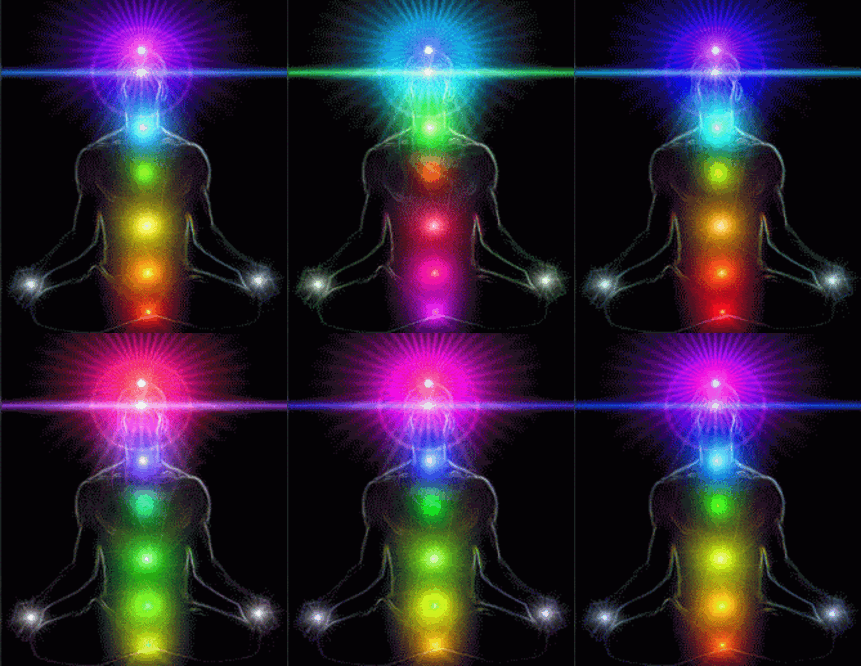
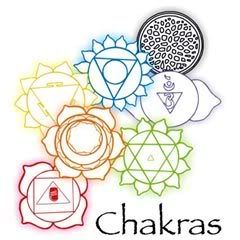
The chakras are portals or structures which help to channel and integrate subtle energies into the physical body.

The body has 7 primary chakras but over 2000 secondary ones which help to direct and hold the integrity of our 3 main elements – mind, body and spirit. 

Since the flow of this triad is always shifting, directed by our intent and consciousness, so too must the chakra system recalibrate and find new points of balance which each shift.

In other words, just as our thinking, communication, perspectives and intentions change, so do the requirements of our chakra systems.

The chakra system deals mainly with subtle energy and so for the most part this energy is able to move through subtle shifts of tension within the physical body. With enough subtle tension however, the flow of energy will slow and even stop. 

The result is that the body, mind and emotions will begin receiving less and less information. Information will result in less understanding and less understanding will lead to less ability.

Usually this does not happen in a dramatic way, it may take years, the same way that plumbing can take years to clog up and eventually block the flow of water.


Depending on which chakras are blocked or limited, the physical and mental consciousness will exhibit various manifestations. 

Blockages in the solar plexus for instance can result in a lack of will or strong intent to take action. This will be experienced in the body as a lessening of the bio-chemicals that create the sensation or emotion of will and purpose. Emotionally and mentally this will be experienced in corresponding mind states such as apathy or boredom. 

Blockages in the crown chakra will result in a disconnection from the Higher Self, as well as a difficulty connecting to the bigger picture in ones life. Just as with the solar plexus chakra, specific bio-chemicals will correspond to this particular blockage.

CLICK ON IMAGE TO ENLARGE

The link between the energy of the chakra and the bio-chemistry of the body is simply about information. There is nothing mysterious about it at all. Our whole being exists and survives because of information. 

There is information between the heart and the brain, information between organs and enzymes, hormones and blood, oxygen and lungs, as well as information from the outside world such as people, books, trees, the sun, the moon, gravity and electricity. 

Information is influence and expression, through connecting with this information a communication happens. This is the same communication that occurs between the energy of the chakras and the physical body.


The foundation ‘foot in the door’ principles to any type of chakra balancing should begin with simply spending time at the chakra location. Forget about what is written in books, references or even here for that matter. 

Nothing will compare to actual ‘sit down’ time with your own chakras.

Its like spending time with a loved one, kids, friends and so on – we can go out and seek advanced knowledge and professional advice but sometimes what is really needed is simply to spend time with them. It’s the same deal with the chakras. 

An amazing amount of communication will open up when we just listen and observe – and in this listening a great deal of balancing and integration will just happen.

The results will be seen in the way the physical body feels, the mind thinks, the emotions move and the spirit flows through us.


Bookmark and Share

Balancing Masculine & Feminine


by Shirley Knapp - 

This is not about the battle of masculine and feminine where many continue to get frozen in time. It is not about war with each other. It's about embracing the understanding of the masculine and feminine within each of you so that you can bring it as a piece of whole truth, not half-truth.

The feminine spirit that has been reawakened in all here on the planet, out of considerable necessity, will help heal the Earth -- it must be reawakened for ultimate healing of the planet. 

Each of you have a masculine and feminine energy in your being and both need to be activated and brought to an equal place.

If you're doing battle with the outside masculine and feminine gender, you can assume that you are most definitely in inner conflict with yourself. You need the balance of both aspects of masculine and feminine energy, which has nothing to do with gender. 

It is about energy and this is why, of course, all the confusion at this time which seems to be brought to the focus of sexuality, when that is clearly not the issue.

The issue is of energy. So, when you find others about you who are angry with the opposite gender, ask them to look inside and heal, not project more isolation and separation to the outside world.

The Earth at this time and all beings who walk upon it need to be loved, need to be held, need to be held in community, in connection to Truth, not separate.

It is time to bring balance, because you cannot take the next step without being in balance. You have been walking on one foot. 

You must be at peace --you must be balanced to take these next steps and for those of you who have this illusion that being alone is balanced, you need to take a further, deeper look inside. You can be balanced on the inside emotionally as much as you can be but that is only one piece or one side of the scale.

You had to learn to do the solo to understand and learn the dance. You had to learn to dance by the self so that you did not dance in dependence with another.

However, one can only hold energy so long by the dance of themselves. This is nothing about relationships of the past. This is about connection to energy balances of the now, so that you're walking foundation and truth, not confusion and chaos but balance and harmony. 

Do not find it a coincidence that you will be touched with a new heart-opening situation, whether it be in the connection that you are already in or a further one that will come along the path.

This is the new step to take you higher. This next step needs to be taken so that you will fully understand balance, because when you start to live in balance, you will live a more passionate fulfilled life.

Open to balance and you will open to Joy!

About Author: Shirley Knapp is an internationally recognized spiritual teacher and author of "Sustaining Joy" who leads groups in personal growth. She has been in a holistic private practice, teaching and embracing individuals and groups since 1986. Shirley’s mission is to heal, love and serve the world by transforming ourselves and helping others transform in joy. 
Bookmark and Share

Taking a Stand for Yourself


by Claudette Rowley -

Maintaining balance in your life is a common concern these days, usually posed as an issue of work/life balance.

People who seek work/life balance often want to work less and have more time and energy for family or for other interests. However, I'd like to look at balance through a different lens.

At its core, I believe that maintaining "balance" means examining how fully we value and honor ourselves. And to fully value and honor ourselves, sometimes we need to take a stand. 

We already take stands for causes we believe in, we advocate for our children and champion our friends as they go after their dreams.

Yet sometimes we forget that the most important person to take a stand for is the one we greet daily in the bathroom mirror.

Taking a stand means different things to different people.


Here are some examples:
  • In the midst of a successful career and a growing family, your political consciousness is activated and you join in a protest about an issue close to your heart.
  • You buck the family expectation that you'll use your law degree in a big downtown law firm. Instead, you use your legal skills to protect the environment.
  • You're from a family of artists and writers, but you go to business school instead.
  • You tell your family and friends that you are going to take care of yourself first -starting now.

These are big, life-altering examples. You also take a stand for yourself when you say, for example, "I'm not cooking dinner on Friday nights" or "From now on, I'm leaving work by 5:30pm" or "I'm for the first time committed to losing these 20 pounds".

Sometimes the stand you've taken may not be popular amongst those nearest and dearest to you. And sometimes, you'll feel everyone is cheering you on! Sometimes it's a little of both. In any case, you have stretched into unknown territory.


Tips for Taking a Stand:
  • Gain clarity: What do you want? What action, if any, do you need to take?
  • Carve out some time and space to reflect and listen to yourself. What does your intuition tell you?
  • Recognize that your energy for taking a stand ebbs and flows.
  • Engage your support system. Talk about your goals with people who know you and truly listen.
  • Know that you always have a choice. What may feel like balance one day may not feel like it the next.

When you take a stand for yourself, you contribute to the world in a bigger way than you could ever imagine.

The ripple in the pond analogy fits: When you value yourself and what you need, you inspire others to do the same thing. What would the world be like if each of us took a stand?


About Author: Claudette Rowley - coach and author, helps professionals identify and pursue their true purpose and calling in life. Contact her today for a complimentary consultation at 781.538.6616 or claudette@metavoice.org. Sign up for her free newsletter "Insights for the Savvy" at metavoice.org


Bookmark and Share

The Compassion Syndrome


by Dr. Joan Borysenko -

Contrary to instinct, doing for others isn’t always healthy — for them or you.

When I was 40-something, our two sons were in the throes of their surly, rebellious teenage years and my elderly mother was seriously ill. I was the filling in this parent-child sandwich—and my husband needed an occasional bite, as well.

Meanwhile, I was in charge of research for a Boston hospital’s division of behavioral medicine and personally cared for more than 50 patients a week.

Like many women stretched between the needs of kids and elderly parents, I was almost ready to snap. So why was I fantasizing about getting pregnant one last time before my eggs got too old?


'Tend and Befriend' Response

I had to wait a decade for the surprising answer, but now it comes from a new look at how women cope with stress. When the going gets rough, women respond with a “tend and befriend” response, says UCLA psychologist Shelley Taylor, PhD, author of The Tending Instinct.

Tending, which is a hands-on style of nurturing not only benefits others but also helps preserve the species in times of war and disaster—and helps women chill out.

Herein lies the major tension in a woman’s life.

We are compassionate both by nature and hormonal design and we reduce our stress through caring for others. But pushed to an extreme, tending becomes its own source of stress and we get overwhelmed.


The signs of imminent collapse are obvious. 

First, you begin ignoring your own needs in favor of the needs of others. Let’s say that every fiber in your being is lobbying to go out and walk in nature but your 12-year-old is badgering you to take her to the mall. You do—knowing that you’ve just sold yourself out.

That leads to the next sign of trouble. You start feeling irritable and resentful of the very people you’re trying so hard to care for. That’s when you catch yourself stomping around the house and mumbling, “Doesn’t anybody else ever empty the dishwasher around here?” Why should they? They have you.

Finally, used up and stressed-out, you crash. This may mean getting sick, having an emotional meltdown or just losing motivation and feeling empty inside.

I’ve thought a lot about why women so commonly ignore their own needs and put others first.

A study by UCLA psychologist Rena Repetti, PhD, sheds light on that question. She investigated how men and women manage stress while juggling the dual demands of family and career. Her approach involved asking working parents and their children about daily events.

It turns out that stress at work makes for crabby, nit-picking dads. But moms who have bad days at the office spend more time with their children and are more attentive to their needs. In other words, under stress, women—and not just mothers—have the instinct to tend.

The reasons why we tend are chemical. Tending releases oxytocin, a hormone that makes women feel peaceful, calm and centered. 

When I was in the stressful sandwich years, my brain was craving a sustained source of calming oxytocin—thus the fantasies about having another child. Fortunately, reason prevailed. We got a dog instead.

The second hazard of tending is mistaking codependency for compassion.

Rather than letting people learn from the consequences of their actions, codependents often try to save the day. A woman in a relationship with an addict, for instance, may cover up her partner’s bad behavior. But you don’t have to have an addict in your life to fall into the toxic tending trap.

Trying to improve an errant child’s school performance by doing his homework and making excuses for a flaky friend when she is late ultimately hurts their growth.

Failing a class because work isn’t turned in is an important lesson in responsibility. And learning to get away with laziness because someone else picks up the slack is a setup for a life of failure.


The Solution

The solution to all of this is staying mindful of your compassionate nature, noticing when you’ve gone overboard and then being able to quickly make a midcourse correction. This is not selfish. It’s wise.

As natural nurturers, women need to develop the discernment and strength to know when helping is healthy and when it disempowers. 


Tips to help you know the difference

  • Let competent people take care of themselves.
Help out only when they really need you; it empowers them and gives you a break. For example, don’t routinely clean your elderly mother’s home if she can do it herself. Even if she can’t do it all, let her do what she can. She’ll live a longer and healthier life. 
The same reasoning applies to doing chores for your kids and spouse. Unless you’re a saint, you’ll end up embittered and resentful. That’s not the stuff that love is made of. And nurturing releases a bonding hormone in men, too; it’s called vasopressin. So, tending and befriending can be just as good for guys.
  • Make compassion a family affair.
Helping is good for your health as well as your community, and it develops solid values for kids. Young children love to be involved in service projects. Talk with your family about how you can get involved in one, even if it’s only once a month. 
You might volunteer to feed the homeless, collect clothing for children overseas, visit residents in a nursing home, or stuff envelopes for a charity.
  • Find time for close friends.
Tending is only part of how women reduce their stress. Being with friends is the other half of the equation. A good friend will let you know when you’re overdoing it, pass the tissues when you’ve overdone and love you anyway. This is why friendship—real befriending—is the antidote to too much tending.


Bookmark and Share

The Principle of Harmony and Rhythm


by Julia Fairchild - 

This principle is strikingly illustrated by placing a handful of iron filings on a thin sheet of metal and playing a certain musical note near the sheet. Wondrously, the filings arrange themselves into a pattern. Change the musical note and the filings rearrange themselves into another pattern.

Every sound has its vibrational pattern, and the visible filings demonstrate the invisible pattern of the sound.

Our thoughts are like the sound and the circumstances in life are like the iron filings.

The filings have no volition or will of their own. They simply fall into the vibrational pattern of the sound. In the same way, automobiles, money, food, jobs, and relationships have no particular will of their own. Their nature is to follow the direction of the waves of thoughts that we radiate.

Some say, "Look what I created!" Another way that could be said might be, "Look what I attracted!" The word circumstance neatly depicts the process; circum means around; stance means stand. 

Circumstances are the conditions that stand around us, magnetized to us by the central core of our thought forms. Change the thoughts at the center of the energy field, and we change the conditions that stand around us.

There is a basic rhythm to all God’s creations – including us.

We notice it when we are quiet enough to listen. Each of us has a natural rhythm. Life is simple when we hear, feel and follow in harmony and rhythm. 

Meditation visualization improve the ability to hear, feel and become more sensitive our inner self and the world around us.

 As we practice being quiet, the inner self teaches us and we will see that miracles are natural expressions of love.

Often a piece of music is called beautiful because of the interplay and harmonious synchronization of the notes.

 In fact, some music (such as Baroque) can actually program our format a person’s brain to facilitate learning. This harmonious interplay extends beyond the music for our ears.


The infinite intelligence of the universe is behind the rhythm and harmony we need in our lives.

As we become more practiced in using these principles, we realize the natural guidance is always there for us, forming a life into a divine pattern.

To increase our harmony and rhythm, we can increase our understanding of the information we receive from our five basic senses: touch, sight, taste, hearing and smell. Then we can become more aware of our other senses, such as intuition and awareness of energy.

When we are in harmony with these principles we draw upon the powers of nature or heaven. We are aware that all is in harmony; that all things work together for our good.

When we react to anger, confusion, anxiety, or fear in another person, we encourage the other person to believe he is presenting the truth. Another response could be to disregard the illusion the other person is expressing and see him as perfect and joyful.

We occasionally fall into the temptation to perceive ourselves as unfairly treated. We can be treated unfairly only by ourselves. We are only victims of the world, if we think we are.

Rather than what others or the world do to us, it is what we believe they have done to us, or what we believe we have done to ourselves that make up our problems.

Deprivation is the feeling we experience when we feel we are isolated or separate. We then project blame, anger, hate to others. They pick up the signal and play a part for us so we can feel that our anger, hate, or sadness is justified.

This signal is a vibration we radiate in our energy field. It’s somewhat like a call to others to come and play with us.

The signals we emit are received, processed, and reacted upon by those seeking that signal; they are tuned in to our broadcast, our vibration.

The ability to draw conditions to us has tremendous practical implications. 

It means we can use our thoughts to create the life we want. It means we can really change for the better.

It means that things no longer have power over us, for we realize that they are just the manifestation of our thoughts, and nothing more. They are thought forms reacting to the signals we project.

The principle of Harmony and Rhythm is perhaps best expressed in the magic of music. 

Music is a powerful influence in our daily lives. There are three basic ingredients of music: melody, harmony and rhythym. Melody and harmony are universal in nature.

The solar system maintains its order because of the vibrations of each individual planet. They comprise a chord of music which is unique to our place in space.


Rhythm belongs to the earth. 

It is the method whereby a song is broken up into measures and notes are assigned different values of time. It is the rhythm or beat of a song which involuntarily sets your toe to tapping. It is the ingredient of time.

There is another ingredient of music which is absent in some music. 

When it is present, it changes lives.

Even plants and animals respond to it. What is this fourth ingredient?

It is LOVE! 

When music contains this element, it performs miracles! It sets into motion natural forces which begin a tumbler-like action, a turning of the tide in the lives of people.

Research into the science of sound, or vibration, helps us understand that creating music requires the interaction between the right and left brain.

In a very real sense, music transcends the mind and goes directly into the heart! It can be a powerful way to access the ability to feel for those who have endured so much pain that they have dissociated from life and become "past feeling."

While listening to music can penetrate even the hardest heart, the activity of creating music, expressing oneself through music, develops a person’s ability to organize creative thoughts and to express them effectively.

It doesn’t seem to matter whether that creation of music is in the form of humming a tune or in performing in a concert. Feeling will happen!

Researchers have studied Baroque music to discover why it is so powerful in assisting in learning.

The combinations of notes, and the patterns of music create order in the brain in much the same way a computer formats a diskette to implant a grid or map which will allow information to be stored in a location where the computer will know precisely where to go to retrieve it.

Why is order so important? 

To create is to organize that which is unorganized. There is no judgment between order or chaos; both are necessary to the process of growth and creativity. To make use of the information we accumulate throughout our lives, we need to be able to retrieve it.

If there is no order, no system for storing and retrieving that information, it is much like a file cabinet with no separate folders – just piles of stuff. We know it’s in there, yet we aren’t able to find it.

People with Alzheimer’s disease are losing this grid pattern, this map for how to store and retrieve information. Remarkable results are being achieved with Alzheimer’s patients through the use of music technology.

An interesting phenomenon is occurring. 

The elements of the earth, the minds and hearts of the people on the planet are beginning to polarize. There is a gathering of order, a gathering of those who follow the principles which created our universe.

There are multitudes of people making a choice for order. What is left is chaos; that which is in conflict with order.

Each person is responsible to make conscious choices about the level of vibrations which influence them.

When all our levels are in alignment (physical, emotional, mental and spiritual), we are in tune. 

We will feel in alignment with the universe and the principle of harmony and rhythm. We will have once again aligned with the "one song."


This material (other than personal observations by Julia Fairchild) is almost exclusively shared from the Life Skills Manual from the Rapid Eye Institute in Salem, Oregon.

Bookmark and Share

Blueprint for Emotional Balance


by Lillian Moritz -

Even in the best of times, life can be challenging. Sometimes failing health or loss of a job may be at the root of our concerns.

Other times it may be smaller things, such as feeling left out, being criticized or feeling judged by others, that send us for a loop. And that's the focus of this piece.

Disapproval may feel uncomfortable but it can also be instructive and helpful. When someone reacts negatively to you or doesn't respond at all, it may actually be their issue and have nothing at all to do with you.

If you receive a criticism that is valid, this is an excellent learning experience and opportunity for you. It offers the chance to see things you may not have been aware of before, from which you can learn.

I've found that the most painful criticism is often self-inflicted and usually off base. Becoming more aware of these kinds of situations early on can help you nip them in the bud, so to speak. 

This allows you to stop the downward emotional spiral before it gets into full gear.

An important part of our natural maturation process is a gradual shift in our sense of 'self' from a perspective that is based on what others think or say about us, to a self-image that is based on our inner values and personal awareness of who we are at the deepest level of our being.

Another way to perceive this inner sense of self is to think in terms of our soul essence, rather than just our human-personality self. 

As we gradually deepen the inner relationship with our soul essence, we become less vulnerable to criticism directed toward us from others.

However, there is still value in this external feedback, as we strive to become more the person that we want to be - in alignment with and an expression of our pure soul essence, or essence self.

There is no shame in criticism that is directed at you by others or even by yourself. Both present opportunities for awareness, insight and growth. Self-criticism provides a unique opportunity to forgive yourself, get over old programming and become more self-accepting and self-loving.

Just because someone doesn't acknowledge you in a positive way, or ignores you outright, or disapproves of you in some way, doesn't mean you're at fault, much less a failure.

Other people's biases are often reflected in their actions and judgments, and that is fine. Everyone is entitled to their point of view and belief. It doesn't make it right or mean it's an accurate assessment.

Even a series of events where you are not acknowledged - involving different people - doesn't equate to your being less good, less valuable, less lovable or less cherished. Think of the millions of things you've done well, beautifully in fact or 'above and beyond the call of duty.'

Do you uphold and value these positive examples of yourself anywhere as close to the few blips on your personal radar? Probably not. Isn't it time to look at the true and accurate balance sheet that mirrors the beautiful person you are?

Your worth is evident to yourself and others but others can't really judge your true value.

Rather, they can only provide their opinion of you based on things you say or do - a small sampling of who you really are as expressed by your outward behavior.

Rejection happens to everyone, to one degree or another. 

It doesn't mean there will be a contagion of rejection flowing from a single disappointing experience. Try not to take it to heart. Accept the comments that come to you and see if you resonate with them.

Then grow from each and every one of these learning experiences, reflecting on those that don't fit or apply to you for what they are - opportunities to become more aware and learn from it.

Lack of acknowledgement can be uncomfortable and push your buttons, but this feeling can and will pass. Brush yourself off and move on - doing one of many simple yet effective wellness exercises that will help you raise your vibration and lighten your emotional load.

Using any of a number of simple techniques can help you put things in perspective and get back to a place of emotional balance, smoothly and quickly.

A good reminder is to not magnify other people so they become larger than life.

Everyone has his or her own issues, biases and blind spots. And we know that nothing stays constant. Others will change, modify and even forget things, just like you.

We're all human. Bask in the knowledge that you are beautiful, whole and perfect, just as you are!


Bookmark and Share

People Pleaser Pitfalls


by Gwen Randall-Young -

I have worked with many clients who experience frustration and even resentment upon realizing they have been pleasers all their lives. It may have begun when, as children they realized that life was more pleasant when you did what others wanted you to do.

This pattern can persist into adulthood, particularly for those who are very sensitive or have low self-esteem. The sensitive one cannot tolerate the thought of an angry or hurt reaction coming their way. They will go to great lengths to avoid conflict or even disagreement.

For one with low self-esteem, it has to do with approval. They do not want others to disapprove of them (they do that well enough to themselves).

 To avoid risking the disapproval of another, they will go out of their way to anticipate the needs or wishes of others, and will act upon those without even being asked.

Over time, the pleaser gets out of touch with what he or she really needs for the self.

The approval or good opinion of others has superceded fulfilling one's own wants and needs. The pleaser will often express the view that it is “selfish” to put one's own needs ahead of those of others.

The truth is that there must be a healthy balance. 

If we are not in tune with ourselves and do not honor what we know we need, health and wellbeing will ultimately be affected. Depression or anxiety may result, as well as physical ailments.

If you notice there is a discrepancy between what you think and feel inside and what you say and do on the outside, it is time to take stock and correct the imbalance.

Harmony comes when there is alignment between our inner and outer worlds .


Bookmark and Share

The Chakras and the Planets


by Lynn Claridge - 

Each chakra and planet corresponds to how you interact on a daily basis with others and the environment.

Each chakra and their corresponding planets:

The first chakra is better known as the base chakra and the planet that it represents is Saturn. Saturn refers to the body’s structure. Your skeleton is a structure that holds your body in place, it acts as a foundation. 

Your bones are the security and structure these are the keywords for the 1st chakra. It represents the structure that you need to survive physically when dealing with life.

If you are unable to deal effectively with outer social structures, that can be a very common problem in western culture of today, it could be that you have forgotten how to ground yourself with the energies of the earth. 

If you are a grounded person you will have a strong sense of who you are, and you will know how to acquire what you need in order to survive comfortably. Nervousness and anxiety are conditions that result from not being grounded. Psychologically, it indicates that you are operating too much from your head, your ego.

To open this chakra you need to take a deep breath relax and look around you. Are you safe where you are at this time? This chakra awareness puts you in the mode of fight or flight. This awareness is a serious energy that requires you to make tough decisions. To help you strengthen this chakra you need to establish healthy routines, drink lots of fresh water, eat healthy foods, have a good night’s sleep and exercise.

The second chakra is better known as sacral chakra and the planet it represents is Pluto. Pluto gives you the ability to change and transform. Once you change and transform you start to become creative. 

Doing this in your everyday life, helps you to meet your needs this in turn allows you to focus on what your life has to offer.

To open this chakra you need to honor yourself by finding something that gives you pleasure, so that you can express who you are to others.

The third chakra is better known as the solar plexus chakra and the co-rulers are the Sun and Mars. This is the chakra of personal power. Think of the symbolic energies of the sun. The sun radiates its essence; it can either blind you or enable you to enjoy its presence by honoring your own inner essence. 
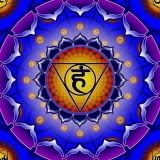
Mars becomes the warrior that enjoys pushing others around or responds to life challenges with inner strength. If you lack the will to take risks, it normal means this chakra is blocked, it can show you are afraid to express yourself because you have not learned how to set limits.

To open this chakra you need to practice personal courage. Do what makes you feel happy, not what makes everyone else happy. When you fail to do so, you waste too much personal energy blaming others for not being able to do what you would rather be doing. 

Do it, be yourself! When you do so, others will recognize your individuality, and they will know what your limits are. They will respect you more because they will know what to expect of you. As long as you are allowing others to also be themselves, do not allow yourself to be swayed by accusation of selfness.

Before we move on to the next four chakras I would like to point out that the first three chakras deal with self-awareness. It is also important to point out that these chakras need to be balanced before you can move on to the higher spiritual realms of awareness.

The fourth chakra, better known as the heart chakra is ruled by the planet Venus. Your ability to love (both loving to others and being able to receive expressions of love from others) acts as a fulcrum between the lower three chakras of self awareness, and the upper three chakras of awareness. 

This chakra of balance is the first place where you are able to perceive higher spiritual realms. If you have suffered emotional hurt, you would tend to block the fourth chakra. This is because you are afraid to make yourself vulnerable. This is a deliberate act of creating an emotional wall as a method of self protection.

The way to open this chakra entails having to go beyond who you are. At this level, you need to become aware of the vibrations, magnetism or resonance that you feel when you are around others. Spirit will start to provide you with synchronizations that will attract and direct you to people or events that are beneficial for your evolution as a soul.

The fifth chakra, known as the throat chakra corresponds to Jupiter and Mercury as its co-rulers. When this chakra is, open it makes you very persuasive and charismatic; often you can be a great teacher, a good speaker or a good writer. 

You have a natural ability to sense what others are thinking, and you can put it into words. Once this chakra is open and functioning correctly, you will be able to speak your personal truth with conviction. 

Once you are able to speak your own truth, then you are able to create your own reality through power of words. If this chakra is not working smoothly, you tend to limit your conversations to superficial concerns and when someone asks you for a serious opinion, you may respond with. “If you really want to know”

To open this chakra you need to pay attention to all your thoughts specially the ones you do not express. How often do you bite your tongue? You need to understand that it is OK to speak your mind. Sometimes you do not speak the truth because you fear you will appear foolish. This chakra allows you to speak words that come directly from the heart, and to express your innermost beliefs.

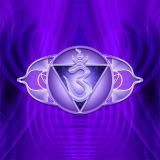
The sixth chakra is known as the bow chakra, however, most commonly it is known as the third eye. The planet that rules this chakra is Neptune. Once this chakra is opened you will become highly imaginative, you will come up with original and insightful ideas. 

This is because you are allowing this chakra to feel incoming messages, intuition and dreams. Usually, the whole concept appears suddenly, and then you become driven in an effort to share and express your message with others. If this chakra is blocked you can have a lack of imagination.

To open this chakra and in order for the energy to function smoothly you must have an awareness of yourself as a spiritual being. For this chakra to work you need to have all the other five chakras balanced, otherwise the incoming visions create a chaotic disturbance of images. Live a lifestyle that has support and a healthy routine. 

Attend to your dreams (keep a dream journal) meditate at regular times and listen to your unconsciousness. Being intuitive is nothing more than paying attention to the subtle flow of energy. Allow yourself quiet moments so you can hear that inner voice, everything you need to know is right here inside your mind. However, it does not and will not scream at you.

The last and seventh chakra is known as the crown and it corresponds to the planet Uranus. At this level of awareness, you are able to see all events as a reflection of spirit. 

When it is out of balance trying to express yourself can be extremely depressing and confusing. Because this chakra operates at such a high vibrational frequency, you must become selfless. Hanging onto your ego awareness brings up images of bleakness.

To open and strengthen this chakra you must become empty to become full. Many spiritual writers refer to the body as an empty vessel that best expresses its spiritual potentials when it allows itself to be moved by spirit. In order for this chakra to function effectively, you need a clear understanding of your purpose on this planet.


Bookmark and Share

Are You a Highly Sensitive Person?


by Christiane Becht -

Being Highly Sensitive can have its ups and downs. Many people suffer from being easily drained and depleted, feeling overwhelmed, being on an emotional roller coaster or running on low energy. 

They know that if this goes on for too long they risk burning out or becoming ill. What they don’t know is that these ‘symptoms’ are very common amongst highly sensitive people.

The majority of these people, though, haven’t considered themselves as being highly sensitive. The label ‘highly sensitive’ often has a bad reputation, being perceived as a weakness while the many gifts and talents of sensitivity are often overlooked. Or, even more common, they are taken for granted!

The type of intelligence and intuition that comes with high sensitivity is, by those who have it, often perceived as something ‘normal’, and highly sensitivity people assume thateverybody feels or thinks in the same way. 

Even those people who do recognize themselves as highly sensitive, don’t always know what to do with it. And there is a lot that can be done – and a lot that can be discovered!

My Story

I have only detected my level of sensitivity over recent years. I would frequently find myself feeling so exhausted or overwhelmed after so-called normal life situations that I would wonder how I would survive the next one.

I dreaded the next business meeting. They felt so harsh to me and I wondered why other people didn’t seem to feel as ‘bruised’ as I did. I started hoping I wouldn’t run into a particular, chronically negative, neighbor who would constantly complain to me because I would feel so drained after getting dumped on by her.

I started to avoid dinner parties where people would tease, gossip, complain or exchange shallow conversation because I would end up going home not feeling recharged, but depleted. It made me feel so lonely and I would ask myself “Why can I not just enjoy myself? Why am I such a weirdo??” 

When I started to pay more attention to how I felt during and after each meeting and encounter I started to become aware of my sensitivity and over time, I learned some quick and simple tools that made my life so much easier (and more effective!). 

Through this process, I discovered that there are gifts to being highly sensitive that can become such a joy and can truly enrich your life.

If my story rings a bell and has got you thinking about your own experience, why not take this short, 11-question quiz that will help you evaluate whether or not you, too are a highly sensitive person.

Am I Highly Sensitive? The Quiz

Do the following things happen to you? (Answer ‘yes’ or ‘no’)
  1. You feel drained after a conversation, even a casual one.
  2. You walk around feeling ‘unprotected’ and wonder how you can protect yourself better from the world.
  3. You walk around ‘very guarded’ as you deliberately try to protect yourself and not show too much of yourself.
  4. You find your job, your environment, your daily life ‘gets to you’ so much that you don’t know how to recover from it at the end of the day.
  5. You feel overwhelmed with information, emotions and energies coming at you from people, conversations, emails, news or movies on TV, maybe even background noise or electrical machines.
  6. You sometimes ‘hit a brick wall’, realizing you have let other people take way too much of your space and energy.
  7. You often have a feeling of what is going on in others - even when they try to hide it. You ‘feel’ everyone around you and sometimes feel overwhelmed by it.
  8. You sense when someone is pretending or lying.
  9. You find things painful that other people find normal, for example, while they talk aggressively or tease laughingly, you feel irritated or hurt.
  10. You feel stuck when people around you are being insensitive, harsh or energy-draining, and don’t know how to get away from the situation.
  11. You would love your relationships, work place, and the entire world to be more harmonious, joyful, peaceful and cooperative and you cannot easily be content with ‘this is just how things are’.

If you said Yes to seven or more questions you are most likely a highly sensitive person.


If you answered five with a Yes then you are probably a highly sensitive person but are maybe not as alert to it and the effect it is having on you. You could try taking these questions into your daily life and see whether you detect more of these in everyday situations.

Highly sensitive people might feel a bit lost in this world, and maybe even really desperate at times, thinking “I can’t cope with my life, it feels overwhelming. But what are my options? I can’t just stop going anywhere - and I don’t want to - but how can I survive in this world?”

So if you know that you are highly sensitive - or suspect that you may be - it is really important to learn about your sensitivity and what you can do with it. 

There are so many tips & tricks to discover that will help you live your life more easily and effectively. And once you learn to ‘survive’ better in your environment, you can then discover how your sensitivity can help you thrive in the world, be a lot more successful and also live your life more joyfully.

If you know (or suspect) you are highly sensitive, we have a lot more information and tips coming for you in future articles! 

If you want to learn more but don’t want to wait  you can buy our book, Your Energy in Action! ‘Energy Balancing’ for Daily Living, which talks a lot about how highly sensitive people can work with energy to recover quicker from irritating or energy-draining situations and encounters. 

More articles from Christiane:


  • How to Survive as a Highly Sensitive Person in Today’s World

  • How to Be a Better Communicator in Personal Relationships

  • Finding yourself when you no longer know who you are


  • About Author: CHRISTIANE BECHT is a writer, international seminar leader, coach and teacher for Essence Training and the Energy Balancing Institute. A native of Germany, she was a first league field hockey player and comes from a background in corporate marketing for Fortune 500 companies like Kraft and Proctor & Gamble. When she was a CEO of her own marketing research company, Christiane first started to notice how the energy of rooms affected people. This observation drove her to embark on the study of Feng Shui, energy healing practices involving chakras and auras, spirituality, mediumship and psychology. In 2005, she became acquainted with Essence Training and Energy Balancing. Passionate about these unique methods, Christiane went on to develop Energy Balancing workshops and courses. After seeing the rapid, positive impact this work had on her clients, she and three of her colleagues went on to co-author the book Your Energy in Action! Energy Balancing for Daily Living. In this work, Christiane brings her extensive practical experience in applying Energy Balancing to “real life” situations, along with her knowledge of how people quickly learn this simple and highly effective method, as a “fast track” catalyst to higher levels of living and personal transformation. 


    energybalancing.me
    Bookmark and Share

    RECENT POSTS